Email exchange with Marco Guerini about early use of Philbrick GAP/R in Italy in the post WW2 period. I share this exchange with permission from Marco Guerini.
The attachments that are mentioned in the correspondence are at the end of the email exchange.
On 3/28/2026 11:27 AM, Marco Guerini wrote:
Dear Mr. Sousa,
I am Marco Guerini, an independent researcher from Italy that’s currently mapping its analog computing historical timeline, applications and developments, in a project called GRANA - Grande Recupero Analogico Nazionale. Through the course of this research I found several early references to GAP/R installations and equipment in the Italian peninsula, going back as far as 1947,
Immediately after the war, a national committee was founded to allow for its recovery and cataloging of any equipment left by the Allied forces. An internal 1947 report records the purchase that year of two calcolatrici analogiche (analog computers) from the States, to be shipped to Torino and Bologna’s Universities.
Subsequent research showed that:
A 1956 internal Bologna publication states that, “ever since 1950” the University had a “calcolatrice analogica ripetitiva ad alta velocità” (high-speed repetitive analog computer) from G. A. Philbrick. It also states that “Various are the universities that possess such a scientific inquiry apparatus”
A 55-pages booklet published in 1951 describes high-speed repetitive computers, with particular detail on the Bologna installation, consistent with the above.
A 1958 mechanical engineering pamphlet describes Torino’s analog laboratory as consisting of two machines, one explicitly identified as a GAP/R installation.
A Philbrick installation is confirmed to have been present at University of Genova by 1964, though the exact installation date remains unknown.
Issue 1 of the Lightning Empiricist, 1952, independently confirms 3 major Italian installations at the time: Bologna, Torino, Microlambda (Rome).
Together, these sources suggest that the 1947 procurement record corresponds to the early Philbrick systems documented in Bologna and Torino. This would place Italy among the earliest international adopters of Philbrick computers, a remarkable fact given the limited commercial availability of GAP/R systems in the late 1940s and early 1950s, prior to the introduction of the K2-W. These machines would therefore have been based on K3 Modules.
The Issue 1 of the Lightning Empiricist also mentions a permanent GAP/R representative in Rome, consistent with your 1956 Representatives List. This aligns with my findings that Italy was, to my knowledge, the biggest Philbrick importer in Europe.
I would greatly appreciate any confirmation your Archives can provide regarding early Philbrick imports, including order contracts, correspondence or any pertaining documentation, I’ll also gladly share the primary sources collected, as they appear to fill gaps in the Philbrick timeline.
Kind regards,
- Marco Guerini
On Sun, Mar 29, 2026 at 9:39 PM Joseph Sousa wrote:
Dear Mr. Guerini,
Thank you very much for getting in touch and thank you for helping to expand the history of GAP/R. Very interesting to see the early adoption by Italy of the GAP/R computers.
Nearly all I know has been uploaded to the archive. I could look around to see if I have any books that may make reference to GAP/R and ital. One place I would recommend to find early advertising by GAP/R is www.worldradiohistory.com, in particular their collection of issues for Electronics magazine. They also have a full collection of IRE issues, which may have articles published by scholars in Italy. But the IRE is a relatively narrow resource, because it excludes the wider scientific applications for analog computing.
Please feel free to use any material from the archive.
Is there anything you would like to offer for upload to the Philbrick Archive? You would be credited as the source.
I retired 3 years ago from a career designing Analog-to-Digital converters in IC form for 40 years. My hobby is still electronics engineering, but in different decades ranging back to at least the 1920's. In my hobby travels, I came across an exceptionally beautiful Italian radio from 1933. It is the Marelli Aedo. It has long legs and fluted doors. It is also a full Superheterodyne set. See https://www.radiomuseum.org/r/marelli_aedo.html or google "marelli aedo radio". It had very elegant modern styling. These days I repair and analysed old radios for RadioMuseum.org. I'm currently working on the German Loewe 2H3N radio from 1926. It used the world's first integrted circuit, with internal triodes, capacitors and resistors, just like the first semiconductor ICs that had transistors, resistors and capacitors.
Regards,
-Joe
On Mon, Mar 30, 2026 at 10:22 AM Marco Guerini wrote:
Dear Mr. Sousa,
Thank you for your prompt reply, kind words, and for granting permission to cite material from the Philbrick Archives. I truly appreciate the support.
If you have the opportunity to consult any internal documents or publications that mention a link between GAP/R and Italy, I would be extremely grateful. Even a brief mention would be invaluable for reconstructing the early diffusion of Philbrick machines, especially in the 1947 to 1950 period, which I’m sure must have been rich in developments.
Regarding contributions to the Philbrick Archives: while I’m more than willing to share the sources I have located, I’m not sure how I should handle proper attribution, as many belong to university collections or derive from older publications. I’ll gladly send you the Bologna article: it describes the usage of high-speed computers as aerodynamics flutter simulators in a short two-page document, but includes a significant footnote that confirms Bologna’s 1950 GAP/R installation. Once I retrieve the 1951 booklet through inter-library loan I’ll forward any relevant section as well.
On a personal note, I enjoyed the mention of Marelli Aedo. I’m well aware of many stunning radios from the 20s through the late 40s. If you were to ever come across an “IMCA IF71 Esagamma”, it’s another showpiece like the Aedo. This has six bands with the coils and tuning circuits arranged in a rotating turret-like drum so that each one is self-contained with its dial scale, and it had many international patents. I also restore radios in my spare time: these days I’m working on a "Voce del Padrone" Mod 406 (late 40s), with a beautiful veneered briar cabinet.
Thank you again for your cooperation and assistance.
Best regards
- Marco Guerini
On 4/12/2026 3:36 PM, Marco Guerini wrote:
Dear Mr Sousa,
I hope you’re doing well. I’m writing just to ensure that my previous email didn’t get buried in your inbox.
I’d also like to make a correction to my earlier statement. The third historic pre-K2W computor identified as per my research was indeed from Microlambda, but further evidence indicates that it was probably housed in Naples, rather than Rome as I had originally suggested.
Best regards,
- Marco Guerini
On Wed, May 6, 2026 at 8:42 PM Joseph Sousa <k2w@philbrickarchive.org> wrote:
Dear Mr. Guerini,
Thanks for the update.
I have taken a look through my paper materials and have not found any direct links to early analog computers in Italy.
I found a few related items. One is the Palimpsest , which may contain references to Italy.
Another reference is the Philbrick representative in Italy in the mid-1960's:
This came from one of their company pamphlets.
Another resource to explore is worldradiohistory.com. They have free downloads. I found these international electronics magazines there:
https://www.worldradiohistory.com/Electronic-Design.htm
https://www.worldradiohistory.com/Electronics%20_Master_Page.htm
https://www.worldradiohistory.com/IRE_Proceedings.htm
Another possible reference is "IRE transactions on electronic computers" (ISSN 0367-9950). https://ieeexplore.ieee.org/xpl/RecentIssue.jsp?punumber=5407885 You will need academic or professional access for these.
Regards,
-Joe
On 5/7/2026 4:10 AM, Marco Guerini wrote:
Dear Mr. Sousa.
Thank you again for the generous amount of material and links you’ve kindly sent.
The representative address you mentioned is especially interesting, as I was able to locate two earlier Philbrick representatives through your Archives:
CICE, Via Umbria 7, Rome (1952, Lightning Empiricist Issue 1)
Via Asmara 7, Rome (1956, Philbrick Representatives list)
The 1956 address was known to have served both the Italian and European markets.
It is notable that at least three other analog computer representatives in the 1950s–60s operated from Milan. A representative there would make sense (hence the address you've sent), although Rome remained a central hub for international traffic, commerce and research institutions.
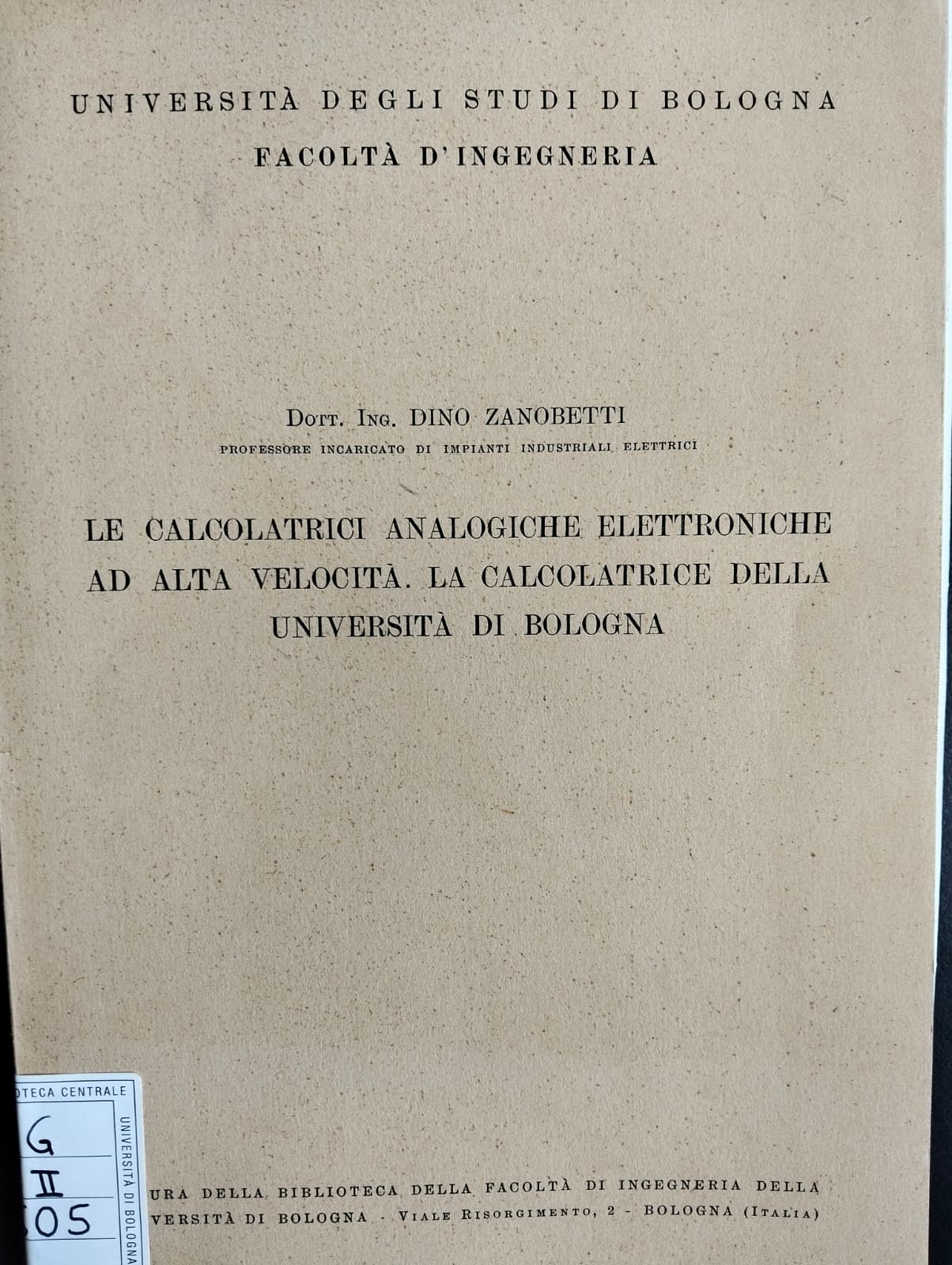
The 1951 Zanobetti booklet, which documents the installation at University of Bologna, arrived a couple weeks ago. From it, I have extracted:
A hardware list and quantities
An installation photograph
A description of a custom K4-sized module, implementing a very complex servo transfer function (around a dozen K3 modules)
If useful, I can send you such material for the Philbrick Archives contribution. These are my own research notes and paraphrased notes; the rights to the original documents, including the installation photograph itself, remain with the Università di Bologna.
The other two 1950s computers, the installations in Turin and Società Microlambda in Fusaro (Naples) are less detailed, though a possible picture of the Turin machine is being recovered. Several papers have surfaced regarding applications of the Microlambda installation, including weather research.
An interesting 1958 technical publication recounts the fate of the Turin Philbrick. Installed in its Aeronautics Laboratory, it was operational by 1951. During a 1958 visit, a professor noticed the machine was “ferma e silenziosa” (shutdown and silent). The official explanation was given as “lack of classrooms”, which thus made “impossible to use the machine for student training”. The final fate of the computer is still uncertain.
If any of this material is of interest, I would be glad to send it over.
Regards,
- Marco
On Sat, May 9, 2026 at 1:06 AM Joseph Sousa <k2w@philbrickarchive.org> wrote:
Dear Mr Guerini,
Thanks for the extensive response. Any material you would like to post in the Philbrick Archive is always welcome.
Regards,
-Joe
On 5/12/2026 11:46 AM, Marco Guerini wrote:
Dear Mr Sousa,
Attached you will find a .zip file containing most of the material I have gathered on the Bologna 1950 installation as discussed in our previous emails.
It contains the following:
Cover photo of the 1951 Booklet which was used as primary sources for most of the material
A document detailing the installation's acquisition, the booklet's contents and other related articles
A second document describing a custom out-of-catalog component and its block diagram
Installation photo, taken from the Zanobetti booklet
I hope this material is of interest to you and to the Philbrick Archives as a whole. As I'll dig deeper and research about the other Philbrick installations (Turin, Naples, Genoa) I'll slowly send you more material to include in the archives.
Kind regards,
- Marco Guerini
On 5/24/2026 3:50 PM, Marco Guerini wrote:
Dear Mr Sousa,
[snip]
Some of the information I initially sent has since been updated as the work progressed, particularly regarding ARAR's involvement with the Bologna and Turin procurement, and also regarding the Genoa installation. After recovering a physical copy of the 1947 report, I can confirm that the material I referenced must belong to a later edition (1948 or later).
As for Genoa, I am currently awaiting a reply from their archives to determine whether the installation can be dated earlier than 1964.
I am working on collecting extra information about the Turin installation: it's quite interesting as it appears to have suffered from rather large errors, in my opinion irreconcilable with Philbrick's specs. These ranged from a few percent to almost 10% .
Similarly, the installation appears to have been used primarily in algebraic fashion, as a partial hardware lists shows (only one K3-J unit, while Bologna had 7). Once I have a document prepared, similar to the Bologna report, I will send it to you.
If anything comes up from my research, I'll send it over.
Kind regards,
- Marco
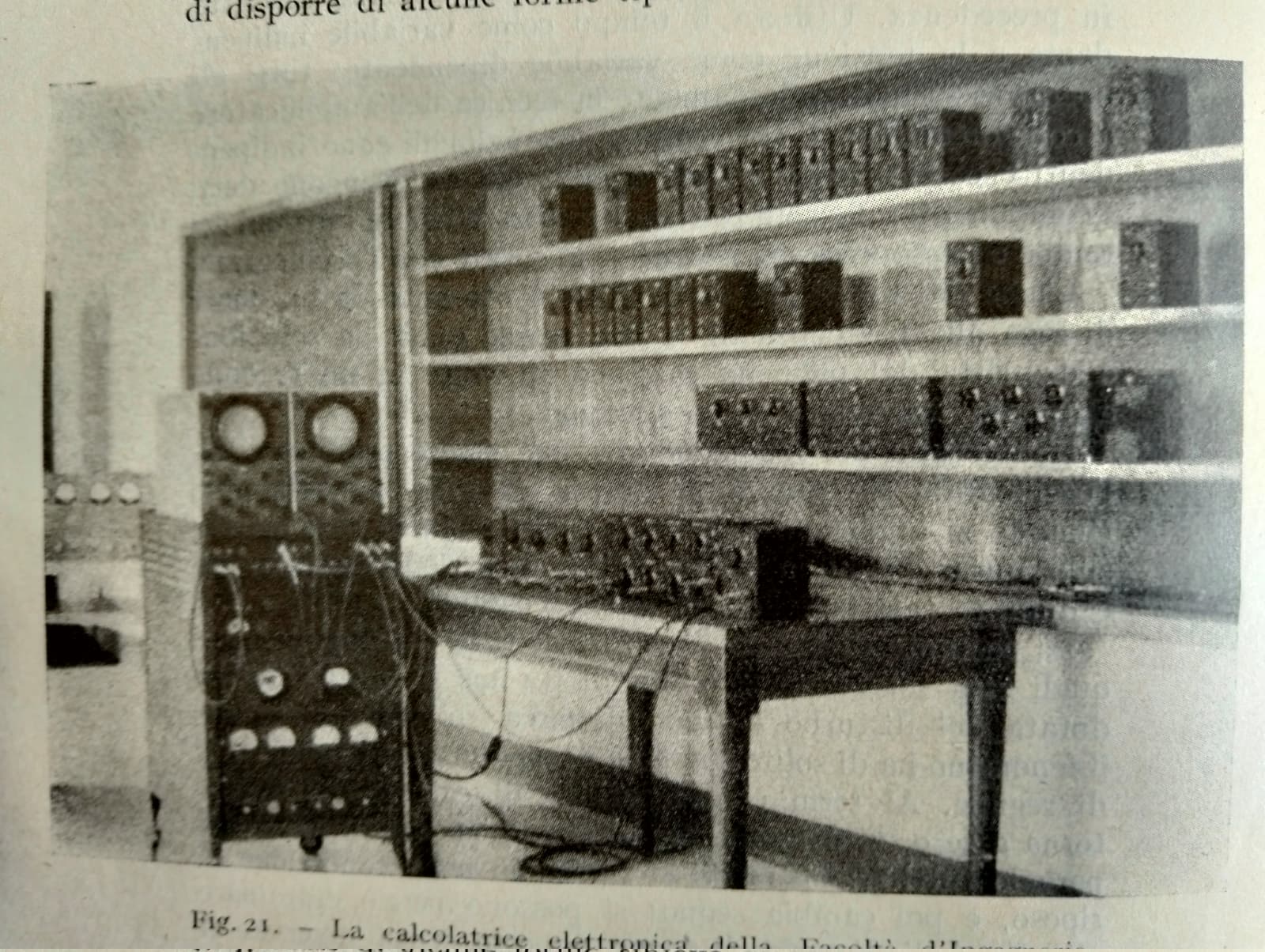
Description of the Philbrick installation in Bologna shown in the photo immediately above. (PDF)
Description of the custom SR component mentioned in the Philbrick installation in Bologna. (PDF)